Permaculture Zones: Designing with Human Nature
One of the things I have always liked about permaculture is that it begins, not with plants, but with people, plants and energy.
Most gardening books ask, "What do you want to grow?" Permaculture asks a different question. "How often will you need to visit it?" It is a deceptively simple idea, yet it changes the way we think about the whole landscape.
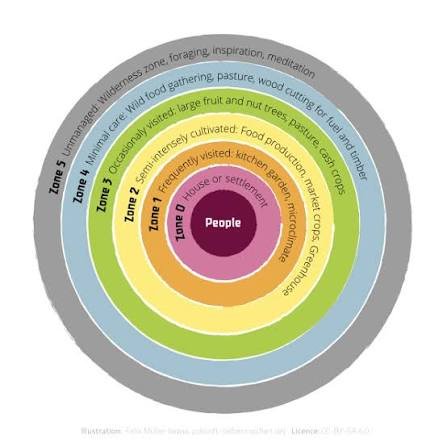
The concept of zones was developed by Bill Mollison and David Holmgren as one of the central design principles of permaculture. Their insight was that a property should be organised according to how often we need to visit different parts of it. Rather than placing things wherever there happened to be space, they suggested arranging them around our daily patterns of movement. The more frequently something requires our attention, the closer it should be to where we live. The less often it needs us, the further away it can be.
Interestingly, the original permaculture texts did not include a Zone 0. The house itself was simply assumed to be the centre from which the other zones radiated. As permaculture matured, however, practitioners began recognising that this overlooked one of the most important parts of the whole system. The home is where we make decisions about food, energy, water, waste and comfort. It is where we prepare meals, wash vegetables, collect compost scraps, store tools and observe the garden. Gradually, the idea of Zone 0 emerged, not as a formal revision of the original system, but as a practical way of recognising that sustainable living begins inside the home itself.
I rather like this evolution because it reminds us that a productive garden is not simply something we build outside our houses. It grows out of the way we live each day.
Zone 0 therefore encourages us to think about the house itself. Does winter sunlight warm the living areas? Can summer heat be shaded? Is rainwater collected? Are compost buckets easy to reach? Can we see much of the productive garden from the kitchen window? These may seem like small questions, but they shape our everyday habits. If we can see ripe tomatoes from the sink, we are far more likely to pick them. If we notice the chickens while making a cup of tea, we are more likely to realise they need fresh water. Good design works because it quietly encourages good behaviour.
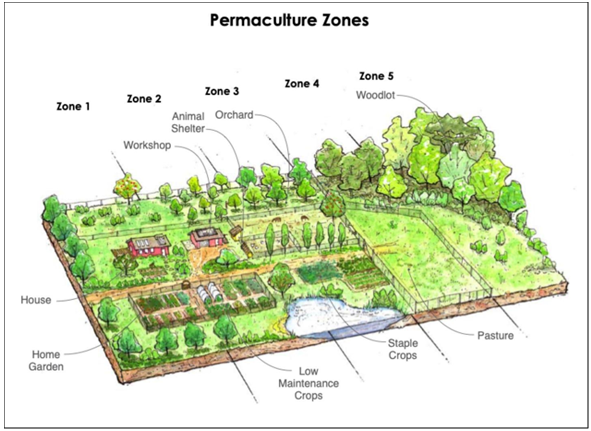
Immediately beyond the house lies Zone 1, the area we visit many times each day. I often suggest asking yourself a simple question. If it were raining, would you still walk out there in your slippers? If the answer is yes, then it probably belongs in Zone 1.
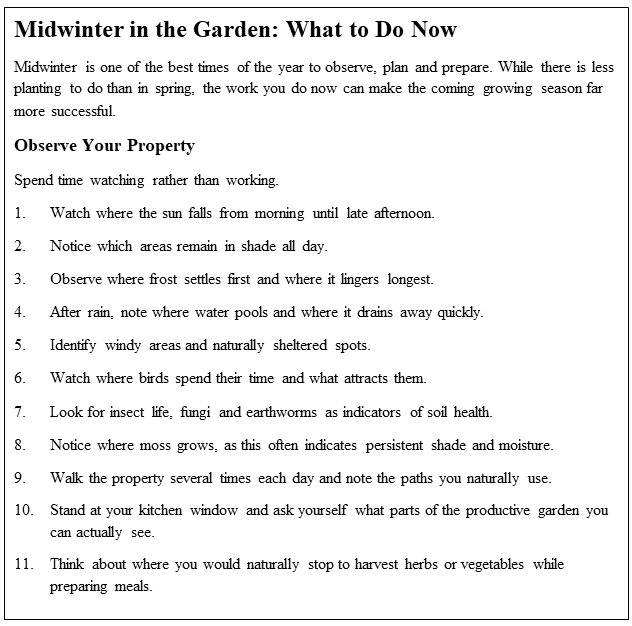
This is where we place the things that reward regular attention. Herbs that we pick while cooking dinner, lettuces for today's lunch, tomatoes that need checking each morning, seedlings that require frequent watering, strawberries that are best harvested as soon as they ripen, the worm farm that receives the kitchen scraps, and perhaps a few favourite flowers that bring pleasure every time we step outside. The point is notsimply convenience. It is about increasing the likelihood that these tasks actually happen. The less effort something requires, the more consistently we do it.
I often see beginning gardeners make the same mistake. They carefully select the very best patch of soil for the vegetable garden, only to discover that it is a long walk from the house. Before long, the vegetables receive less attention than they deserve, not because the gardener lacks enthusiasm, but because life gets busy. In permaculture, good design almost always beats perfect soil. Soil can be improved. Human habits are much harder to change.
Beyond this lies Zone 2, where productive systems continue but demand less frequent attention. Established fruit trees, berry bushes, asparagus, rhubarb, perennial vegetables, larger compost systems, chickens and beehives often fit comfortably here. These are things that may only require checking every few days rather than several times each day. They are still highly productive, but they have become more self-sustaining.
When you begin to look at a property through the lens of the zones, you notice something rather remarkable. They are not really about plants at all. They are about reducing unnecessary effort. Every extra trip carrying a watering can, every forgotten handful of herbs, every walk to feed the chickens adds time and energy to our day. A well-designed garden quietly removes thousands of these small inefficiencies over the course of a year.
The good news is that you do not need to wait until spring to begin. In many ways, midwinter is one of the best seasons for permaculture because there is less pressure to plant and more opportunity to observe.
Over the next week, simply pay attention to your own movements. Which door do you use most often? Which path do you naturally follow? Where do you pause to look across the garden? These everyday habits will tell you where your Zone 1 really belongs.
Winter is also the perfect time to notice the sun. With the sun lower in the northern sky, you can clearly see which parts of your garden receive precious winter warmth and which remain shaded throughout the day. If you are planning new vegetable beds or fruit trees, these observations will be invaluable when spring arrives.
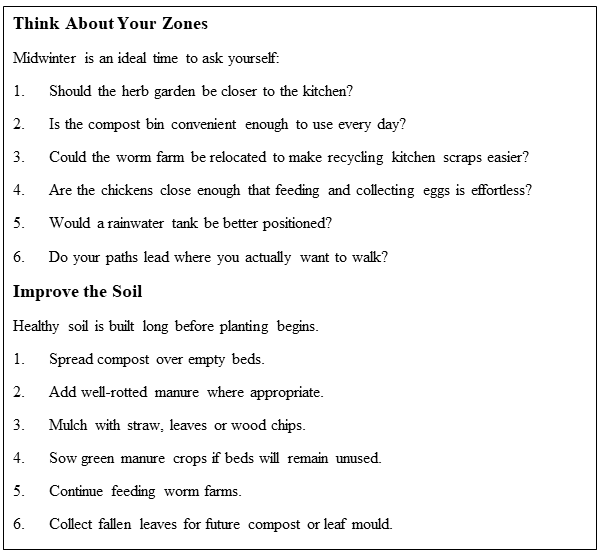
Take the opportunity to sketch a simple map of your property. Mark the house, existing trees, taps, sheds and fences. Then ask yourself whether the garden fits the way you actually live. Would herbs be more useful beside the back door? Would a compost bucket be emptied more often if the compost bin was only a few steps away? Could a rainwater tank make watering easier? Often the smallest changes make the biggest difference.
Winter is also an ideal time to feed the soil. Compost, aged manure, fallen leaves and mulch added now give earthworms and countless soil organisms several months to do their work before spring. By the time the weather warms, the soil is often healthier, richer and easier to cultivate.
If you have deciduous fruit trees, winter is generally the time to prune, removing damaged or crossing branches and encouraging a strong framework for the coming season. It is also an excellent opportunity to clean and sharpen tools, repair fences, check irrigation systems and think about whether your paths actually lead where you want them to go.
Perhaps the hardest advice to follow is also the simplest: resist the temptation to rush out and buy plants.
Bill Mollison often encouraged people to spend time observing a place before trying to change it. Watch where frost settles. Notice where water lies after rain. Observe which parts of the garden dry first and where birds spend their time. Every season teaches us something, and every observation makes the next decision a little wiser.
That, I think, is one of permaculture's quiet strengths. It recognises that successful gardens are built not only around the realities of being human, but around the realities of the natural world as well. The two are not separate. We shape the garden, and in turn the garden shapes the way we live within it. When our design works with both human nature and nature itself, the result is less work, greater abundance, greater resilience and a deeper sense of belonging to the place we call home.