Victoria's Forests: More Than Trees
Reporting on the State of our Forests
There is something about entering an old Victorian forest that immediately changes us.
The air cools almost without us noticing. The scent of damp eucalyptus leaves rises from the forest floor where countless generations of leaves have slowly returned to the soil. Light filters through towering Mountain Ash and Messmate in broken shafts that never quite reach every corner of the understorey. Tree ferns spread their fronds towards the filtered light while mosses soften fallen logs that have been quietly returning to the earth for decades. Somewhere high above, the slow, unmistakable call of a Yellow-tailed Black Cockatoo drifts through the canopy before the birds themselves come into view. Nearby, a Superb Lyrebird scratches patiently through the leaf litter, turning over leaves in search of insects hidden beneath. Nothing seems hurried.
Most of us have had moments like this. We stop talking without quite knowing why. We breathe a little more deeply. We slow our pace. Even children often become quieter. There is a sense—difficult to describe but immediately recognisable—that we have entered somewhere different.
Many people would simply say the forest feels peaceful. Ecologists might offer a different explanation. They would tell us that what appears to be a collection of trees is, in reality, one of the most complex living communities on Earth. Beneath every step lies an intricate network of roots, fungi, bacteria, insects and countless other organisms, each contributing to a web of relationships that has been developing for centuries. Water is being filtered and stored. Nutrients are being recycled. Carbon is being captured and locked away. Seeds are germinating. Fungi are breaking down fallen timber. Birds are dispersing seed and regulating insect populations. Life is continuously supporting life, even though very little of it is visible to us (Lindenmayer & Laurance, 2017).
Perhaps this is the first surprise. We enter the forest thinking we are surrounded by trees.
We are actually standing within relationships.
For a long time, Western science tended to study the separate parts of nature—plants, birds, mammals, soils or rivers—as though each could be understood in isolation. That work has taught us a great deal. Increasingly, however, ecologists have come to recognise that the true strength of a forest lies not in its individual parts, but in the relationships between them. A forest is not simply where trees grow. It is a living community whose members continually create the conditions that allow one another to survive.
Aboriginal peoples have known these forests as Country for tens of thousands of years. Country is not merely land or vegetation. It is a living community to which people belong and for which they hold responsibilities. While Western ecology has arrived at this understanding through careful observation and scientific investigation, it is recognising something that First Peoples have long understood through lived relationship: that life is sustained through connection rather than separation.
That simple shift changes the way we see everything that follows. If a forest is merely a collection of trees, then it can be measured by the number of trees it contains or the timber it produces. If a forest is a living community of relationships, we begin asking different questions altogether:
How does it sustain itself?
What happens when those relationships are broken?
And why do some forests become richer, more resilient and more alive as they grow older?
Those questions take us to the heart of Victoria's forests—and perhaps to the heart of our own relationship with the natural world.
The Quiet Work of Forests
As we continue along the track, it becomes increasingly difficult to escape the feeling that the forest is busy, even though so little appears to be happening. There are no engines, no machinery and no obvious signs of activity, yet every part of the forest is engaged in work that has been unfolding continuously for thousands of years. The longer we walk, the more we begin to realise that almost nothing here exists in isolation.
High above us, the broad crowns of Mountain Ash and Messmate are quietly harvesting sunlight. Through photosynthesis, the leaves draw carbon dioxide from the atmosphere and convert it into sugars that build trunks, branches, bark and roots. At the same time, water absorbed from the soil is lifted high into the canopy before slowly returning to the atmosphere through millions of microscopic pores in the leaves. This process, known as transpiration, cools the trees, contributes moisture to the atmosphere and plays an important role in the movement of water through forest ecosystems and the regulation of climate (Bonan, 2008; Ellison et al., 2017).
As our eyes adjust to the forest, we begin noticing things that would otherwise escape attention. The rough bark of an old Messmate supports mosses, lichens and tiny invertebrates. A branch that fell years ago has become coated with fungi that slowly return its nutrients to the soil. A fallen Mountain Ash, softened by decades of decay, is now supporting ferns, mosses and young seedlings. Ecologists describe these fallen giants as coarse woody debris or nurse logs because, long after the tree itself has died, it continues to retain moisture, provide habitat and recycle nutrients that sustain new generations of life (Lindenmayer & Laurance, 2017; Lindenmayer et al., 2012).
Beneath our feet, however, an even more remarkable story is unfolding. A handful of healthy forest soil contains billions of bacteria, kilometres of fungal hyphae and an extraordinary diversity of microscopic life. Together they recycle fallen leaves, bark and timber into nutrients that become available to the next generation of plants. Many fungi also form mycorrhizal partnerships with tree roots, exchanging water and minerals for sugars produced through photosynthesis. These relationships improve nutrient uptake, increase drought resilience and contribute to the functioning of healthy forest ecosystems (Smith & Read, 2008; van der Heijden et al., 2015).
Even the small creek crossing the walking track reflects these relationships. After heavy rain, water does not simply rush downhill. The forest canopy intercepts part of the rainfall, while leaf litter, fallen timber and organically rich soils absorb and store much of the remainder. Water then moves slowly through the soil before feeding streams and rivers over weeks and months. Healthy forests therefore play an important role in reducing erosion, improving water quality and regulating stream flows, making Victoria's forested catchments critical to the State's water security (Ellison et al., 2017; Keith et al., 2009).
It is easy to overlook these processes because they happen continuously. We notice the dramatic events—a bushfire, a flood or the sound of a chainsaw—but rarely pause to consider the countless relationships that quietly sustain the forest every moment of every day. Scientists often describe these benefits as ecosystem services (Millennium Ecosystem Assessment, 2005), although the phrase scarcely captures what is really occurring. Forests are not consciously providing services for us. They are simply functioning as healthy forests, and in doing so they create many of the conditions that make our own lives possible.
By now we have probably stopped thinking of the forest as a collection of trees. Instead, we begin to see a living community held together by relationships. That realisation naturally leads to another question. If every forest performs this remarkable work, why do ecologists place such importance on old forests? What is it about age that makes such a profound difference?
Why Age Matters
At first glance, the difference between a young forest and an old forest seems obvious. One has slender trunks, an open canopy and the appearance of vigorous growth. The other is dominated by towering eucalypts, deeply furrowed bark and fallen timber slowly returning to the soil. Yet the most important difference is not the size of the trees. It is the amount of time the forest has had to develop.
Ecologists have increasingly recognised that the value of an old forest lies in its structural complexity. As forests mature, their architecture changes. Large trees develop broad crowns and massive limbs, bark becomes thicker and more deeply fissured, dead standing trees remain within the landscape, fallen logs accumulate across the forest floor, and a rich diversity of mosses, lichens, fungi and invertebrates gradually colonise every available surface (Franklin et al., 2002; Lindenmayer & Franklin, 2002; Lindenmayer & Laurance, 2017). None of these features develops quickly. They are the product of decades and often centuries of uninterrupted ecological processes.
These changes are far more than aesthetic. Each new feature creates opportunities for other forms of life. Rough bark provides shelter for insects and spiders. Mosses retain moisture through dry periods. Fungi decompose timber and return nutrients to the soil. Fallen logs provide habitat for reptiles, amphibians, invertebrates and small mammals while also acting as seedbeds for ferns and young eucalypts (Harmon et al., 1986; Lindenmayer et al., 2012). As complexity increases, so too does the number of ecological niches available to plants and animals, allowing mature forests to support a far greater diversity of species than forests in the early stages of regeneration (Lindenmayer & Franklin, 2002).
Professor David Lindenmayer and his colleagues (2014) describe large old trees as keystone structures. The term is used deliberately. Just as the keystone of a stone arch supports the entire structure, these trees support ecological functions far beyond what might be expected from their relatively small numbers. Large old trees provide food, nesting sites, shelter, shade, stable microclimates and habitat for hundreds of species. Their influence extends into the soil through extensive root systems and associated mycorrhizal fungi, while their eventual death contributes large quantities of coarse woody debris that continues supporting forest life for decades (Lindenmayer et al., 2014; Lindenmayer & Laurance, 2017).
Perhaps the easiest way to appreciate this is to think differently about an old tree. Rather than seeing a single organism, imagine a living neighbourhood. A mature Mountain Ash supports epiphytes on its branches, insects beneath its bark, fungi within its timber, birds feeding among its canopy, gliders moving between its limbs and mammals sheltering within hollows that have formed over generations. Even after the tree falls, it continues to retain water, stabilise soil and recycle nutrients while providing habitat for countless organisms (Harmon et al., 1986; Lindenmayer & Laurance, 2017).
This is why ecologists place such importance on protecting large old trees. Seedlings can be planted in a single day, but the ecological characteristics that distinguish an old forest cannot be manufactured. They develop only through time. A forest recovering from disturbance may require many decades before it begins to resemble a mature ecosystem, while some features, particularly large hollow-bearing trees, may require well over a century to reappear naturally (Gibbons et al., 2010; Lindenmayer & Laurance, 2017).
Time, therefore, is not simply another variable in forest ecology.
It is one of the forest's most important architects.
The significance of this becomes even clearer when we look closely at one feature found almost exclusively in older Australian forests: the tree hollow.
You Cannot Hurry a Hollow
If there is one feature that illustrates the value of old forests better than any other, it is the tree hollow.
To many people, a hollow is little more than a hole in the trunk of an ageing tree. It is easy to overlook as they walk through the forest, or even to see it as evidence that the tree is unhealthy or beginning to die. Ecologists see something entirely different. A hollow is one of the rarest and most valuable habitats in Australian forests, representing the culmination of ecological processes that have often been unfolding for well over a century (Gibbons & Lindenmayer, 2002; Lindenmayer & Laurance, 2017).
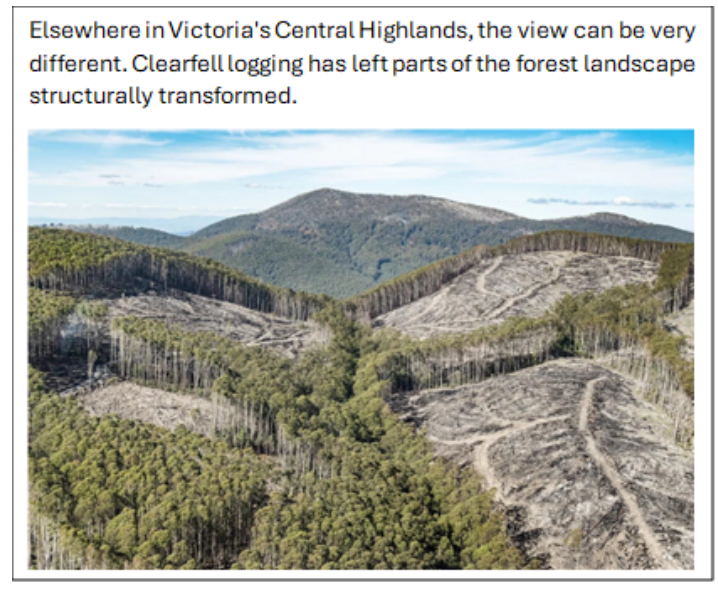
Unlike Europe and North America, Australia has almost no woodpeckers capable of excavating nesting cavities. Instead, hollows develop slowly through a combination of growth, ageing, fungal decay, insect activity, fire scars and the natural shedding of branches. It is an extraordinarily slow process. Small hollows suitable for some birds and mammals may take many decades to develop, but the large cavities required by species such as Yellow-tailed Black Cockatoos, Powerful Owls and Greater Gliders commonly require well over 120 years and, in many forests, closer to 180 or even 200 years before they become suitable habitat (Gibbons et al., 2010; Lindenmayer & Laurance, 2017).
It is difficult to comprehend these timescales because they sit so far beyond ordinary human experience. A Mountain Ash seedling germinating after a bushfire today may still be growing when our grandchildren have reached old age. Only then might it begin developing the hollows that another generation of cockatoos or gliders will require. Nature is working to a timetable that bears little resemblance to our own.
For the Yellow-tailed Black Cockatoo, the search for a nesting site is not simply a search for a tree. It is a search for history. The hollow must be deep enough to protect eggs and chicks, wide enough for an adult bird approaching sixty centimetres in length, and secure enough to withstand years of wind and weather. Suitable hollows are surprisingly scarce, and breeding pairs often return to the same nesting tree over many years if it remains intact (Department of Climate Change, Energy, the Environment and Water [DCCEEW], 2024).
The story is repeated throughout Victoria's forests. Powerful Owls raise their young in large tree hollows, while Greater Gliders spend their days sheltered within cavities that protect them from heat and predators. Brush-tailed Phascogales, parrots, microbats and many reptiles also depend upon hollows that exist only because trees have been allowed to grow old (Gibbons & Lindenmayer, 2002; Lindenmayer et al., 2014). It has been estimated that more than 300 Australian vertebrate species use tree hollows during some part of their lives, making hollow-bearing trees one of the most important structural features in the Australian landscape (Gibbons & Lindenmayer, 2002).
This is why the loss of a large old tree cannot be measured simply by counting one less tree in the forest. The loss is ecological rather than numerical. When a hollow-bearing tree disappears, it is not merely timber that has been removed. Homes disappear. Nesting sites disappear. Refuge from summer heat disappears. A living structure that may have taken two centuries to develop is gone, while the forest begins the slow process of creating another.
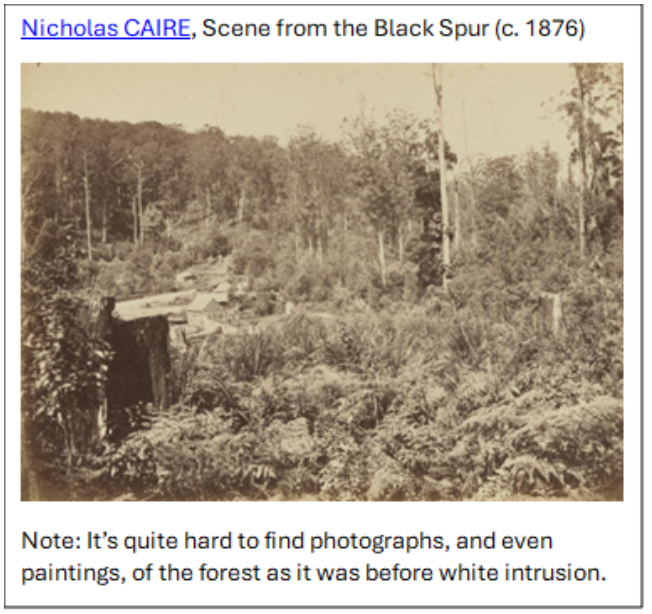
There is both hope and humility in this understanding. Young forests regenerate remarkably well after disturbance, and Victoria contains extensive areas of regenerating native forest that, if protected and wisely managed, will continue to develop increasing ecological complexity over coming decades. Yet some of the features that distinguish old forests cannot be hurried. They emerge only through time, reminding us that conservation is not simply about protecting what exists today. It is also about allowing ecological processes the centuries they need to unfold (Lindenmayer & Laurance, 2017).
Perhaps this is why large old trees occupy such a special place in forest ecology. They are not simply survivors from another age. They are living bridges between the past and the future, carrying within them the accumulated history of the forest and quietly supporting generations of life that would otherwise have nowhere to live.
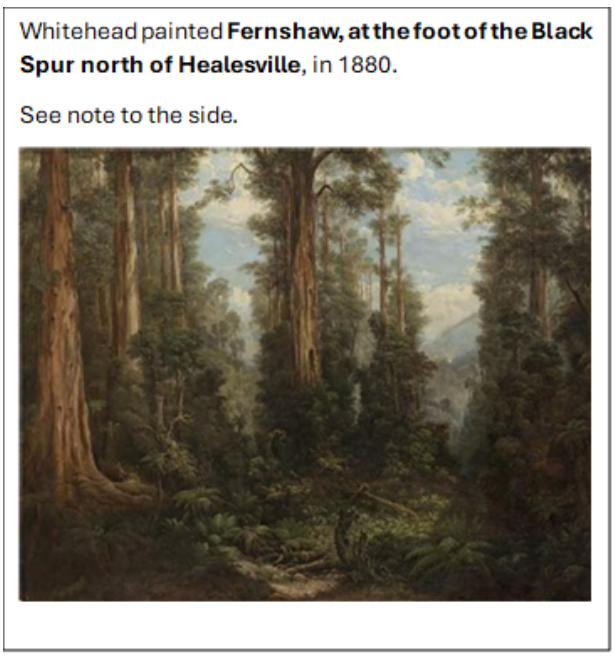
The next time we encounter a hollow in an old eucalypt, it is worth pausing for a moment before walking on. Rather than seeing an empty space within a tree, we might recognise it for what it truly is: a home patiently crafted by nature over the course of centuries.
Note: The painting shows enormous mature and old-growth Mountain Ash rising above a dense, wet understorey of tree ferns, rainforest trees and wattles. Lindenmayer's 2024 paper specifically discusses this painting and concludes that it depicts mature–old-growth Mountain Ash forest, noting that despite the major 1851 fires, the forest Whitehead painted appears not to have been affected. Importantly, it is a dense, structurally complex forest, not an open stand of evenly aged eucalypts.
Where Do Victoria's Forests Stand Today?
Having walked through an old forest and begun to appreciate the work it performs, the question naturally arises: how healthy are Victoria's forests today? The answer is neither simple nor entirely reassuring.
Victoria remains one of Australia's most forested states, with approximately eight million hectares of native forests and woodlands covering around one-third of the State (Department of Energy, Environment and Climate Action [DEECA], 2023). From the tall Mountain Ash forests of the Central Highlands to the dry box-ironbark forests of central Victoria, the cool temperate rainforests of East Gippsland and the River Red Gum forests of the Murray floodplains, the State retains an extraordinary diversity of forest ecosystems. Yet area alone tells us remarkably little about ecological condition.
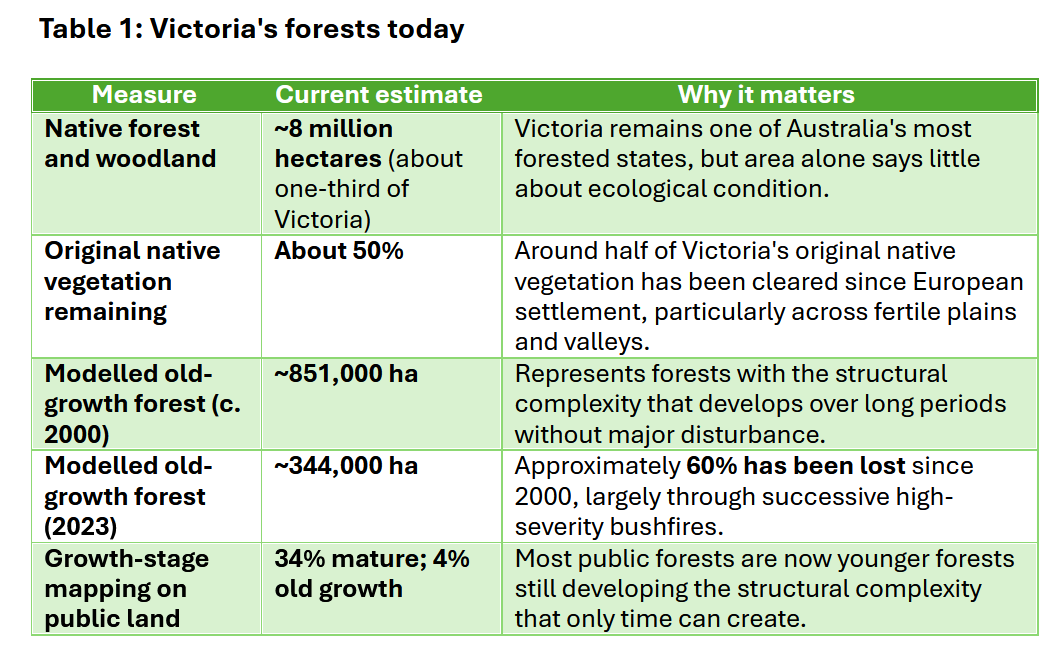
Sources: Department of Energy, Environment and Climate Action (2023); Victorian Commissioner for Environmental Sustainability (2023); Victorian Bushfire Risk Management Report (2022–23).
These figures tell an important story. Victoria has not run out of forests. What has become increasingly rare are forests that have been allowed to mature over centuries. Much of the native forest we see today is regenerating after past logging, repeated bushfires or other disturbances. These forests remain immensely valuable. They protect water catchments, store carbon, provide habitat for wildlife and, given sufficient time, many will develop the complexity of mature forests. Some will eventually become old growth.
This distinction matters because a mature or old-growth forest is far more than a collection of large trees. It represents centuries of ecological relationships slowly accumulating. Hollows form. Soils deepen. Fungi spread through intricate underground networks. Fallen logs decay, becoming homes for insects, reptiles, mammals and the next generation of plants. We can plant seedlings in an afternoon, but we cannot plant a two-hundred-year-old forest. That inheritance can only be passed from one generation to the next.
In this sense, perhaps the rarest resource in Victoria's forests is no longer timber. Or specific species. It is time.
A plantation is not the same as a regenerating native forest. A regenerating forest is not the same as a mature forest. A mature forest is not the same as old-growth forest. Each performs valuable ecological functions, but they differ greatly in their structural complexity, the habitats they provide and the ecological relationships they support (Lindenmayer & Franklin, 2002; Lindenmayer & Laurance, 2017).
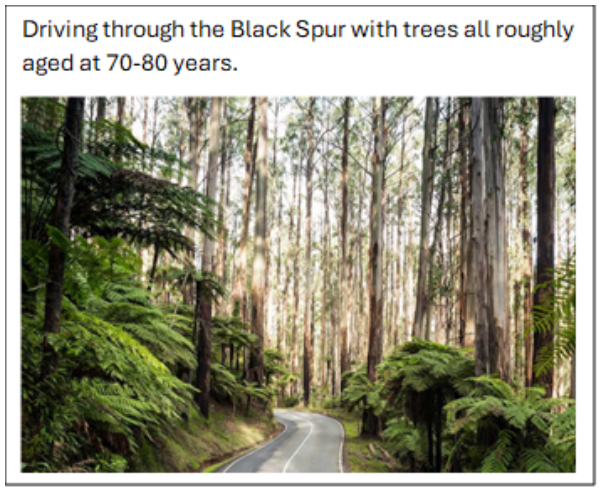
This distinction is often overlooked in public discussion. We sometimes hear that Victoria has "millions of hectares of forest", implying that the forests are therefore secure. Ecologically, the more important question is not simply how much forest remains, but how much of it retains the complexity that develops only after long periods of uninterrupted growth.
Recent assessments suggest that only a relatively small proportion of Victoria's forests retain the characteristics associated with the highest ecological condition or old-growth structure, while much larger areas consist of forests recovering from past logging, repeated bushfires or other forms of disturbance (DEECA, 2023; Victorian Commissioner for Environmental Sustainability, 2023). This does not mean these regenerating forests lack value. On the contrary, they are the old forests of the future. If protected from repeated disturbance, they will continue developing increasing structural complexity over coming decades and centuries.
The greatest challenge facing Victoria's forests is no longer commercial native forest logging. Following the Victorian Government's decision to end native forest harvesting on public land in January 2024, one of the major chronic pressures affecting many forest ecosystems has been substantially reduced (DEECA, 2024). That decision has created an opportunity for forests to continue maturing, allowing large trees, dead standing timber and hollow-bearing habitats to become more abundant over time. Recent modelling suggests this transition is likely to benefit many threatened forest-dependent species, including the Greater Glider, Leadbeater's Possum and several hollow-dependent birds and mammals (Watson et al., 2025).
The challenges that remain, however, are profound. Climate change is increasing average temperatures, extending fire seasons and creating more frequent periods of extreme fire weather (IPCC, 2023). Severe bushfires in 2009 and again during the Black Summer fires of 2019–2020 affected vast areas of Victorian forests, including many ecosystems already recovering from previous fires (Bowman et al., 2020). Repeated high-severity fires can interrupt forest recovery, reduce the number of large old trees and diminish the availability of the hollows upon which so many Australian species depend (Lindenmayer et al., 2011).
Other pressures continue to accumulate. Introduced predators such as foxes and feral cats affect native mammals and birds. Weeds alter forest understoreys and compete with native vegetation. Phytophthora cinnamomi and other plant pathogens threaten susceptible species, while expanding urban development fragments habitats and isolates wildlife populations (DEECA, 2023).
Taken together, these challenges remind us that conservation is no longer simply about preventing loss. Increasingly, it is about rebuilding resilience. It is about restoring ecological relationships, reconnecting fragmented landscapes, protecting large old trees, supporting Traditional Owner-led management of Country and allowing forests sufficient time to recover their remarkable complexity (Lindenmayer & Franklin, 2002; Lindenmayer & Laurance, 2017). Perhaps that is the most encouraging aspect of Victoria's forests today.
Despite everything they have experienced - clearing, logging, mining, drought, storms and repeated bushfires - they remain astonishingly resilient. Walk through many forests only a few years after fire and young eucalypts once again reach towards the light, wattles flower across the hillsides and lyrebirds scratch through fresh leaf litter. Life persists with remarkable determination.
The question is no longer whether forests can recover. The question is whether we are willing to give them the time they need.
More Than Trees
By now it has probably become clear that forests cannot be understood simply by counting trees. A forest is not the sum of its individual parts. It is the relationships between those parts that give it life. Remove enough of those relationships and the forest may still look green from a distance, yet much of what made it ecologically rich has already been lost.
This is perhaps one of the most important lessons modern ecology has taught us. Throughout much of the twentieth century, scientists often studied species separately. Birds were studied by ornithologists, fungi by mycologists, insects by entomologists and trees by botanists. Each discipline contributed enormously to our understanding of the natural world. Increasingly, however, ecologists have come to recognise that the behaviour of the whole forest cannot be understood simply by studying its individual components. The interactions between species, soils, climate, water and disturbance often prove just as important as the species themselves (Odum & Barrett, 2005; Chapin et al., 2011).
The same principle applies well beyond forests. Healthy rivers depend upon healthy catchments. Productive soils depend upon microorganisms almost entirely invisible to the naked eye. Pollination depends upon insects whose contribution often goes unnoticed until they disappear. Human societies are similarly shaped by relationships—between people, communities, institutions and the natural systems that sustain them. The health of any complex system depends less upon the strength of its individual parts than upon the quality of the relationships that connect them (Folke et al., 2004).
Forests remind us of this every day. A large old eucalypt does not support birds because it chooses to do so. Fungi do not recycle nutrients because they understand the needs of seedlings. Creeks do not filter themselves through forest soils with any conscious purpose. Rather, millions of years of evolution have produced countless relationships that together create a system capable of sustaining life. Each organism simply follows its own way of living, yet the result is an extraordinary level of cooperation across the ecosystem (Chapin et al., 2011).
There is a quiet humility in recognising this. Modern societies often celebrate independence, self-sufficiency and individual achievement. Forests tell a rather different story. No tree grows alone. Every eucalypt depends upon the soil beneath it, the fungi surrounding its roots, the insects that recycle nutrients, the microorganisms that maintain soil fertility, the pollinators that ensure reproduction and the climatic conditions created, in part, by the forest itself. Even the largest tree is sustained by relationships extending far beyond its own trunk and branches (Lindenmayer & Laurance, 2017; van der Heijden et al., 2015).
Perhaps this explains why time in forests has such a profound effect upon many people. Numerous studies have shown that spending time in natural environments is associated with lower physiological stress, improved mood, better attention and enhanced psychological wellbeing (Bratman et al., 2019; Twohig-Bennett & Jones, 2018). The reasons are undoubtedly complex. Some involve cleaner air, cooler temperatures and opportunities for physical activity. Others may reflect something more subtle. Forests immerse us within living systems whose relationships have been unfolding for centuries, inviting us, if only for a short time, to become part of something much larger than ourselves.
This insight also changes the way we think about conservation. Conservation is not simply about preventing extinction or protecting beautiful places, important though those goals are. At its heart, conservation is about maintaining the ecological relationships that allow life to flourish. Protecting an old tree protects the hundreds of organisms that depend upon it. Restoring a creek restores habitats downstream. Reconnecting fragments of forest allows birds, mammals, insects and plants to move, breed and adapt as climates continue to change (Lindenmayer & Franklin, 2002).
Seen in this way, forests are far more than scenic landscapes or reservoirs of biodiversity. They are living demonstrations of how complex systems endure.
They remind us that resilience emerges not from isolation, but from connection; not from speed, but from patience; and not from the success of individual organisms, but from the countless relationships that quietly sustain the whole. Perhaps that is why forests continue to inspire such awe. When we walk beneath their canopies, we are not simply surrounded by trees. We are walking through one of nature's oldest conversations.
Looking Again
As we leave the forest, very little around us has changed. The Yellow-tailed Black Cockatoos still move slowly across the canopy. The lyrebird continues scratching through the leaf litter. Water still finds its way towards the creek beneath a carpet of fallen leaves. Fungi continue their patient work beneath the soil, while towering Mountain Ash quietly capture sunlight that has travelled almost 150 million kilometres from the Sun. The forest has not changed.
We have.
At the beginning of this walk, it was easy to see the forest as a collection of trees. Now it is much harder to do so. We have come to recognise that a forest is a living community whose extraordinary complexity has developed through countless relationships unfolding over decades, centuries and, in evolutionary terms, millions of years. The towering eucalypts that first captured our attention are only one visible expression of that much larger living system.
This shift in perspective also changes the way we think about conservation. It is tempting to measure success by the number of hectares protected, the number of trees planted or the number of threatened species listed. These measures are important, but they tell only part of the story. Equally important are the ecological relationships that allow forests to function: the fungi that nourish roots, the insects that recycle nutrients, the fallen logs that become nurseries for new life, the large old trees that shelter countless animals, and the healthy catchments that sustain rivers, wildlife and communities alike (Lindenmayer & Franklin, 2002; Lindenmayer & Laurance, 2017).
Victoria's forests face significant challenges. Climate change is altering fire regimes, increasing temperatures and placing growing pressure on ecosystems that have already experienced more than a century and a half of clearing, logging and fragmentation (Bowman et al., 2020; IPCC, 2023). Yet they also possess remarkable resilience. Native forests continue to regenerate after fire. Young forests continue to mature. Species return when habitat recovers. The cessation of commercial native forest logging on public land has created an opportunity for many forests to continue developing the structural complexity upon which so much life depends (DEECA, 2024; Watson et al., 2025).
Whether that opportunity is realised will depend largely upon the choices we make during the coming decades. Some decisions can be implemented quickly. Others require a patience that sits uneasily within modern political and economic cycles. We can plant seedlings this winter, but we cannot plant a two-hundred-year-old hollow-bearing eucalypt. We can restore damaged creeks, but we cannot compress centuries of ecological development into a single generation. The future of Victoria's forests will depend not only upon what we do, but also upon our willingness to allow time itself to remain one of nature's great architects (Gibbons et al., 2010; Lindenmayer & Laurance, 2017).
Perhaps that is the deepest lesson these forests have to offer.
Modern civilisation has become remarkably good at building things quickly. Roads, bridges, cities, factories and data centres can appear within a few years. Forests remind us that some of the most valuable forms of wealth cannot be hurried. They are built through enduring relationships—between soil and fungi, fungi and roots, trees and birds, fire and regeneration, water and catchments, people and Country. Remove those relationships and the forest gradually loses the qualities that make it whole. Protect them, and the forest continues quietly creating life long after we have gone.
The next time you walk into an old Victorian forest, pause for a moment before looking at the trees. Listen instead to the call of the cockatoos overhead. Notice the coolness beneath the canopy, the scent of damp eucalyptus leaves, the softness of moss on a fallen log and the quiet movement of water through the landscape. Remember that you are standing within a community that has been patiently assembling itself for centuries.
Forests are more than trees. They are relationships made visible.
What Can We Do?
By the time we leave the forest, one thing has become clear. Conservation is not simply the responsibility of governments, scientists or park managers. It belongs to all of us. Every person who lives in Victoria is, whether we recognise it or not, part of the ecological story of these forests.
Perhaps the first step is surprisingly simple. Spend time in them.
Walk slowly. Return to the same places through different seasons. Learn the names of the birds whose calls you hear before you see them. Notice the fungi emerging after autumn rain, the changing scent of eucalyptus leaves on a warm afternoon, the coolness beneath the canopy on a summer's day. Forests cease to become "the environment" when they become places we know. We are far more likely to protect what we have come to love than what we know only as an abstract idea.
Our own homes can also become places of conservation. Planting indigenous trees, shrubs and grasses creates food and shelter for birds, insects and small mammals. Even modest gardens can become stepping stones that reconnect fragmented habitats across the landscape. Leaving fallen timber where it is safe to do so, reducing pesticide use and providing water during periods of extreme heat all contribute, in small but meaningful ways, to the resilience of local ecosystems.
Our choices as consumers also matter. Every product we purchase has come from somewhere. Timber, paper, minerals, food and energy all leave ecological footprints that extend well beyond our own lives. Reducing unnecessary consumption, repairing rather than replacing, recycling materials where possible and supporting businesses committed to sustainable practices are practical ways of reducing pressure on the living systems upon which we all depend.
As citizens, we also have a responsibility to support decisions that are guided by ecological evidence and informed by the knowledge of Traditional Owners, whose understanding of Country has been developed through countless generations of lived relationship. Healthy forests are not simply places for recreation. They protect water catchments, store carbon, moderate climate, sustain biodiversity and enrich the lives of millions of Victorians. Decisions about their future deserve careful thought, sound science and a willingness to consider the wellbeing of generations yet to come.
Yet perhaps the deepest contribution any of us can make is less about what we do than how we learn to see.
Modern civilisation has become remarkably skilled at viewing the world as a collection of separate objects—trees, rivers, animals, people and resources. Forests quietly invite us into another way of understanding. They reveal that life is sustained not by isolated individuals but by relationships. The health of the whole depends upon the quality of the connections between its parts.
The same may be true of our own communities.
Perhaps the first task, then, is simply to spend enough time in a forest that it ceases to be "the environment" and once again becomes part of our own community. We protect what we experience as kin.
If enough people begin to see forests in this way, cultural change will follow naturally. We will ask different questions. We will make different decisions. We will begin measuring success not simply by what we can extract from nature, but by the health of the relationships that sustain both the forest and ourselves.
That may be one of the most important gifts Victoria's forests still have to offer us. They remind us that resilience is not built through domination, nor through endless growth, but through patient relationships that allow life, in all its diversity, to flourish together.
References
Bonan, G. B. (2008). Forests and climate change: Forcings, feedbacks, and the climate benefits of forests. Science, 320(5882), 1444–1449. https://doi.org/10.1126/science.1155121
Bowman, D. M. J. S., Kolden, C. A., Abatzoglou, J. T., Johnston, F. H., van der Werf, G. R., & Flannigan, M. (2020). Vegetation fires in the Anthropocene. Nature Reviews Earth & Environment, 1(10), 500–515. https://doi.org/10.1038/s43017-020-0085-3
Bratman, G. N., Anderson, C. B., Berman, M. G., Cochran, B., de Vries, S., Flanders, J., Folke, C., Frumkin, H., Gross, J. J., Hartig, T., Kahn, P. H., Jr., Kuo, M., Lawler, J. J., Levin, P. S., Lindahl, T., Meyer-Lindenberg, A., Mitchell, R., Ouyang, Z., Roe, J., & Daily, G. C. (2019). Nature and mental health: An ecosystem service perspective. Science Advances, 5(7), eaax0903. https://doi.org/10.1126/sciadv.aax0903
Department of Climate Change, Energy, the Environment and Water. (2024). Yellow-tailed black-cockatoo (Calyptorhynchus funereus). Australian Government. https://www.dcceew.gov.au/
Department of Energy, Environment and Climate Action. (2023). State of Victoria's forests 2023. Victorian Government. https://www.deeca.vic.gov.au/
Department of Energy, Environment and Climate Action. (2024). Future forests. Victorian Government. https://www.deeca.vic.gov.au/
Ellison, D., Morris, C. E., Locatelli, B., Sheil, D., Cohen, J., Murdiyarso, D., Gutierrez, V., van Noordwijk, M., Creed, I. F., Pokorny, J., Gaveau, D., Spracklen, D. V., Tobella, A. B., Ilstedt, U., Teuling, A. J., Gebrehiwot, S. G., Sands, D. C., Muys, B., Verbist, B., & Sullivan, C. A. (2017). Trees, forests and water: Cool insights for a hot world. Global Environmental Change, 43, 51–61. https://doi.org/10.1016/j.gloenvcha.2017.01.002
Folke, C., Carpenter, S. R., Walker, B., Scheffer, M., Elmqvist, T., Gunderson, L., & Holling, C. S. (2004). Regime shifts, resilience, and biodiversity in ecosystem management. Annual Review of Ecology, Evolution, and Systematics, 35, 557–581. https://doi.org/10.1146/annurev.ecolsys.35.021103.105711
Franklin, J. F., Spies, T. A., Van Pelt, R., Carey, A. B., Thornburgh, D. A., Berg, D. R., Lindenmayer, D. B., Harmon, M. E., Keeton, W. S., Shaw, D. C., Bible, K., & Chen, J. (2002). Disturbances and structural development of natural forest ecosystems with silvicultural implications, using Douglas-fir forests as an example. Forest Ecology and Management, 155(1–3), 399–423. https://doi.org/10.1016/S0378-1127(01)00575-8
Gammage, B. (2011). The biggest estate on Earth: How Aborigines made Australia. Allen & Unwin.
Gibbons, P., & Lindenmayer, D. B. (2002). Tree hollows and wildlife conservation in Australia. CSIRO Publishing.
Gibbons, P., McElhinny, C., Bird, P., Lindenmayer, D. B., & Manning, A. D. (2010). Characteristics of tree hollows used by vertebrate fauna in temperate forests. Forest Ecology and Management, 260(6), 897–905. https://doi.org/10.1016/j.foreco.2010.06.032
Harmon, M. E., Franklin, J. F., Swanson, F. J., Sollins, P., Gregory, S. V., Lattin, J. D., Anderson, N. H., Cline, S. P., Aumen, N. G., Sedell, J. R., Lienkaemper, G. W., Cromack, K., Jr., & Cummins, K. W. (1986). Ecology of coarse woody debris in temperate ecosystems. Advances in Ecological Research, 15, 133–302. https://doi.org/10.1016/S0065-2504(08)60121-X
Intergovernmental Panel on Climate Change. (2023). Climate change 2023: Synthesis report. Contribution of Working Groups I, II and III to the Sixth Assessment Report of the Intergovernmental Panel on Climate Change. IPCC.
Keith, H., Mackey, B. G., & Lindenmayer, D. B. (2009). Re-evaluation of forest biomass carbon stocks and lessons from the world's most carbon-dense forests. Proceedings of the National Academy of Sciences, 106(28), 11635–11640. https://doi.org/10.1073/pnas.0901970106
Lindenmayer, D. B., Cunningham, R. B., Donnelly, C. F., & Franklin, J. F. (2000). Structural features of old-growth Australian montane ash forests. Forest Ecology and Management, 134(1–3), 189–204.
Lindenmayer, D. B., & Franklin, J. F. (2002). Conserving forest biodiversity: A comprehensive multiscaled approach. Island Press.
Lindenmayer, D. B., Hobbs, R. J., Likens, G. E., Krebs, C. J., & Banks, S. C. (2011). Newly discovered landscape traps produce regime shifts in wet forests. Proceedings of the National Academy of Sciences, 108(38), 15887–15891. https://doi.org/10.1073/pnas.1110245108
Lindenmayer, D. B., Franklin, J. F., Lõhmus, A., Baker, S. C., Bauhus, J., Beese, W., Brodie, A., Kiehl, B., Kouki, J., Martínez Pastur, G., Messier, C., Neyland, M., Palik, B., Sverdrup-Thygeson, A., Volney, W., Wayne, A., & Gustafsson, L. (2012). A major shift to the retention of intact forest structures in sustainable forest management. Conservation Letters, 5(6), 421–431. https://doi.org/10.1111/j.1755-263X.2012.00257.x
Lindenmayer, D. B., Laurance, W. F., & Franklin, J. F. (2014). New policies for old trees: Averting a global crisis in a keystone ecological structure. Conservation Letters, 7(1), 61–69. https://doi.org/10.1111/conl.12013
Lindenmayer, D. B., & Laurance, W. F. (2017). The ecology, distribution, conservation and management of large old trees. Biological Reviews, 92(3), 1434–1458. https://doi.org/10.1111/brv.12290
Millennium Ecosystem Assessment. (2005). Ecosystems and human well-being: Synthesis. Island Press.
Pascoe, B. (2014). Dark Emu. Magabala Books.
Smith, S. E., & Read, D. J. (2008). Mycorrhizal symbiosis (3rd ed.). Academic Press.
Steffensen, V. (2020). Fire Country: How Indigenous fire management could help save Australia. Hardie Grant.
Twohig-Bennett, C., & Jones, A. (2018). The health benefits of the great outdoors: A systematic review and meta-analysis of greenspace exposure and health outcomes. Environmental Research, 166, 628–637. https://doi.org/10.1016/j.envres.2018.06.030
van der Heijden, M. G. A., Martin, F. M., Selosse, M.-A., & Sanders, I. R. (2015). Mycorrhizal ecology and evolution: The past, the present, and the future. New Phytologist, 205(4), 1406–1423. https://doi.org/10.1111/nph.13288
Victorian Commissioner for Environmental Sustainability. (2023). State of the environment 2023. Victorian Government. https://www.ces.vic.gov.au/
Watson, J. E. M., Lindenmayer, D. B., Taylor, C., Blair, D., et al. (2025). Positive impacts of ending native forest logging on biodiversity conservation in Victoria, Australia. PLOS ONE, 20(2), e0319531. https://doi.org/10.1371/journal.pone.0319531